
How to choose a fertility clinic in India: check registration, how care is planned, add-ons and the questions to ask, using NICE and ESHRE guidance.
When you choose a fertility clinic, check three things first: that it is registered under India's assisted reproduction law, that its plan is based on the cause of your difficulty, and that any extra step it offers comes with evidence you can read. A headline success rate on its own is not a reliable way to choose a clinic, because the figure depends on who was treated and how it was counted. The sections below explain why.
Celova is preparing to open a fertility centre in Bengaluru and offers paid online consultations. The centre is in planning, with no confirmed date. Celova does not currently provide treatment, procedures, scans or laboratory tests. Every check in this guide applies to any clinic, including Celova's own centre when it opens.
Is the clinic with the highest success rate the right choice?
Many people assume so. Success figures are easy to find and easy to compare, and they seem to answer the question directly.
They are harder to read than they look. A clinic's figure depends on who it treats, including their ages and diagnoses, how many treatment cycles they have had, and how the clinic counts a result. A cycle here means one full attempt at treatment, from start to outcome. Two clinics can publish different figures simply because they count differently.
Population statistics explain how things work for groups of people. They are not a promise for any one person. When a clinic shares a figure, ask what it counts, who it includes and what period it covers. A doctor who knows your case can explain what a figure might mean for you.
For background on other common beliefs, see common fertility myths and what the evidence says.
What guidelines say about how care is planned
Good planning starts with assessment. The NICE guideline NG257 covers the whole fertility assessment and treatment pathway, including each treatment and when it is offered. It is a useful reference for what a sound plan should include.
NICE recommends an initial assessment for people who are concerned about delays in conception. This includes asking about lifestyle and sexual history, to identify people who may be less likely to conceive (NICE: Defining infertility and initial assessment). Your doctor will explain which tests apply to you. You can read more in hormone blood tests for fertility.
Treatment is organised by cause. The NICE chapter on female factor fertility problems covers ovulation disorders, tubal and uterine problems, and endometriosis as separate areas. Each has its own options, so a clinic plan should name the cause it is treating.
Some people have no clear cause after the standard tests. This is called unexplained infertility. The ESHRE guideline on unexplained infertility (2023) covers investigation and treatment for this group, including intrauterine insemination (IUI) and in vitro fertilisation (IVF). ESHRE also reports that for a large proportion of these tests and treatments, evidence was very limited and of very low quality. That uncertainty is worth understanding before you compare clinics.
Checking that a clinic is registered in India
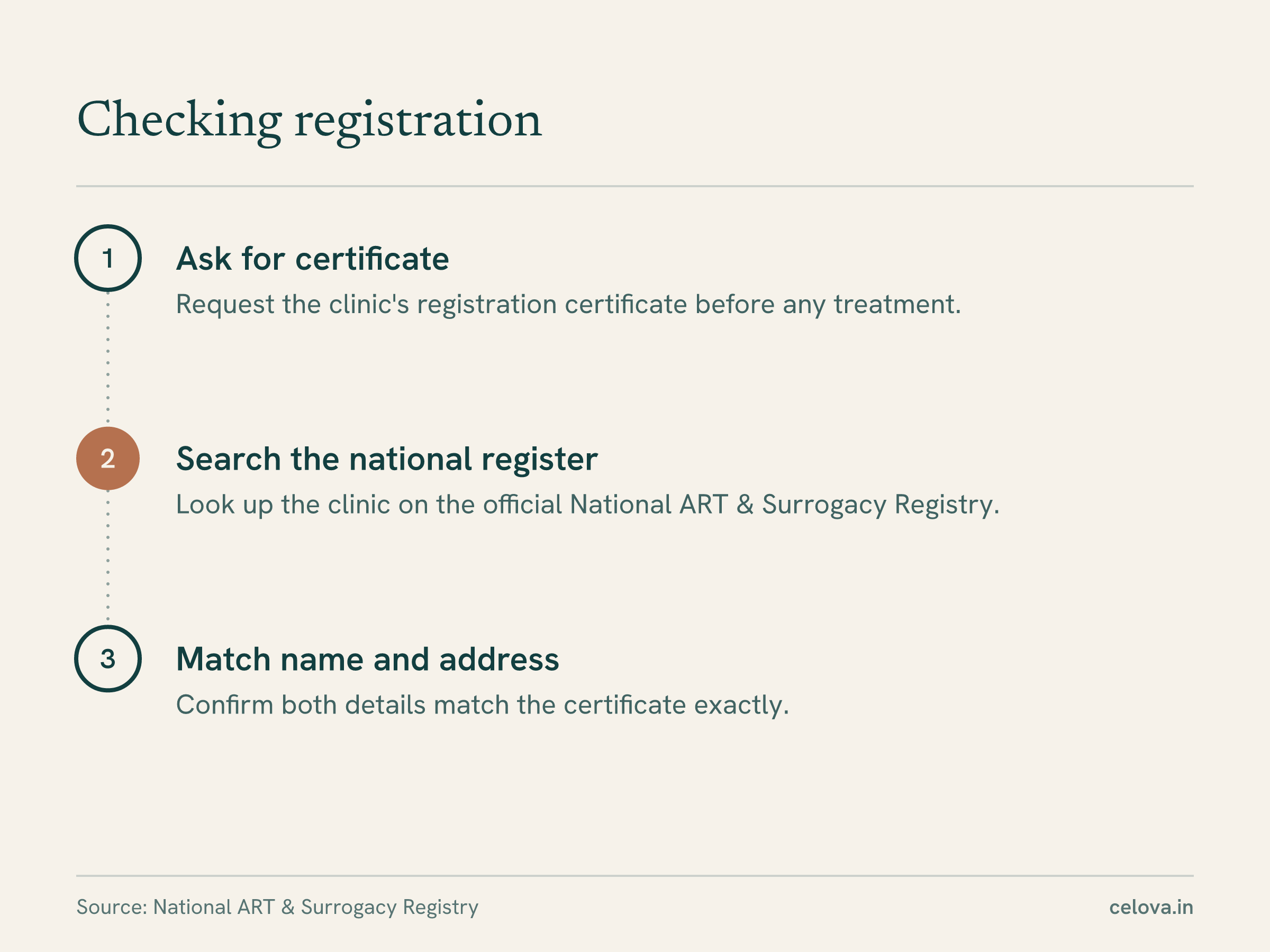
The Assisted Reproductive Technology (Regulation) Act, 2021 provides for the registration of ART clinics and banks. ART stands for assisted reproductive technology, the term the Act uses for these treatments.
The official place to check is the National ART & Surrogacy Registry, kept by the Department of Health Research, Ministry of Health and Family Welfare. Ask the clinic for its registration certificate, and check it against the register, including the name and address.
Celova's ART registry check is a convenience tool for looking up clinics. It does not replace the official register.
This guide does not explain who can receive treatment, age limits, or rules on donor eggs or sperm. These are legal questions. If they affect you, ask the clinic which rules it follows, and check the current text of the Act and its Rules.
How the right order depends on diagnosis and situation
No single order of treatment fits everyone. The right next step usually depends on the cause that has been found or suspected, your age, how long you have been trying, and what your tests show. The guidelines above describe the options and when they are usually considered. They do not set one fixed order for every person.
Where the main concern is ovulation, NICE covers treatments that induce ovulation, including gonadotrophins, which are fertility medicines that stimulate the ovaries (NICE: Management of female factor fertility problems). Where the tubes or womb are affected, the options are different again. NICE recommends considering tubal surgery for mild tubal disease, in centres where appropriate expertise is available (same source).
NICE also says that people offered ovulation induction with gonadotrophins should be told, before starting, about the risks of multiple pregnancy and ovarian hyperstimulation syndrome (OHSS). The same chapter recommends ovarian ultrasound monitoring during this treatment, to reduce these risks (same source). Ask your clinic how it monitors treatment, and what warning signs it will explain to you.
Your doctor may also talk about your ovarian reserve, which the glossary explains. It is one piece of the picture. A clinic that mentions it should explain what the result means for your plan.
Only a doctor who knows your case can say which order fits you. If you want to understand the difference between IUI and IVF, read IUI or IVF? How doctors decide which to suggest.
Questions to ask and add-ons to check
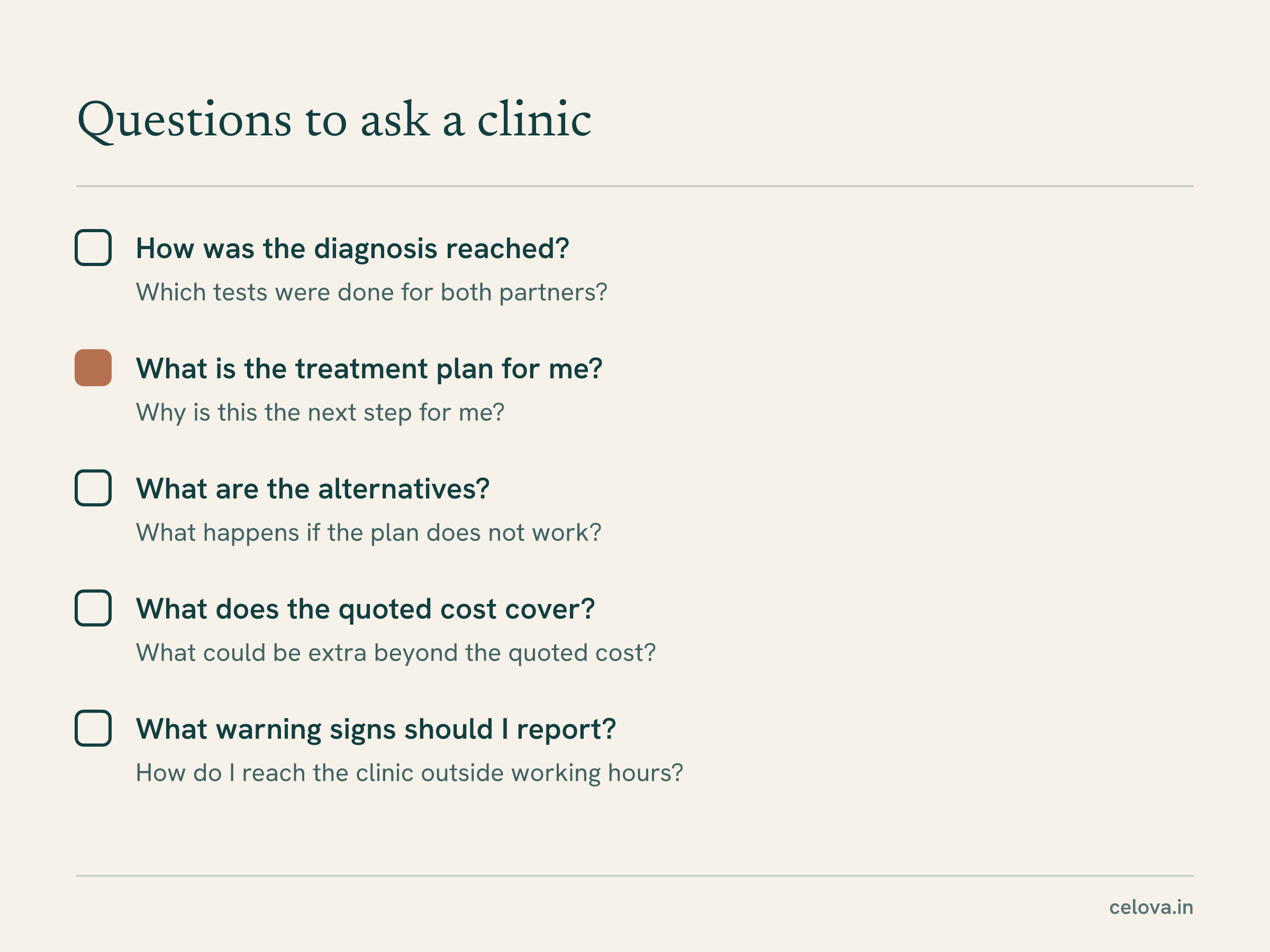
Write your questions down before any appointment. The appointment question builder can help you list them. Useful questions include:
- How was the diagnosis reached, and which tests were done for both partners?
- What is the treatment plan, and why is this the next step for me?
- What are the alternatives, and what happens if the plan does not work?
- What does the quoted cost cover, and what could be extra? For planning, see planning for the costs of fertility treatment.
- What warning signs should I report, and how do I reach the clinic outside working hours?
- If I am worried about pain during a procedure, what can be done about it?
Add-ons are extra steps or products offered alongside standard care. The HFEA: Treatment add-ons page, from the UK fertility regulator, publishes evidence ratings for a number of them. Those ratings come from UK practice, but they show how an add-on can be judged against the evidence. You can use the same approach when you ask questions.
The HFEA page says that some add-ons may be offered for reasons other than improving the chance of pregnancy. It advises you to ask why an add-on is being offered and whether it may benefit you in particular. It also states that treatments without strong evidence of safety or effectiveness should only be offered in a research setting.
If an add-on is described as essential, if you are being hurried to decide, if the explanation stays vague, or if it is linked to a promise of success, pause and ask for the evidence in writing. A clinic that is confident in its approach should be able to show you that evidence and say where it is weak.
What this guide can and cannot tell you
This guide can help you understand how care is usually planned, what to check and what to ask. It cannot tell you which clinic to choose, and it cannot assess your own health.
Dr Shesha Sinha, MBBS, MS (Obstetrics & Gynaecology), is registered with the Madhya Pradesh Medical Council. You can read her profile at Dr Shesha Sinha's profile.
When to see a doctor
NICE sets 1 year of regular unprotected sex without conception as the point at which both partners should be offered further assessment, where no clinical cause is known or suspected (NICE: Defining infertility and initial assessment). For people using artificial insemination, the same source sets 6 cycles as the point for further assessment.
You do not have to wait for that point. NICE recommends an initial assessment for anyone concerned about delays in conception. If you are worried, seek advice sooner. A doctor can tell you whether an earlier review makes sense for your situation.
If a pregnancy has ended, that is a real loss, however early it happened. Pregnancy loss is the general term, and miscarriage is the word many people use. NICE's guidance also covers miscarriage and ectopic pregnancy, which is a pregnancy that starts outside the womb. NICE says that when either happens during the trying period, the timeframe continues and is not restarted (NICE: Defining infertility and initial assessment). You can take that to your doctor, and you do not have to carry the loss quietly.
Seek urgent care at the nearest hospital, or call 112, if you have severe pain, heavy bleeding, breathlessness, or sudden swelling of the stomach, especially during or after fertility treatment. These can be signs of OHSS, which NICE asks clinics to explain before ovulation induction starts (NICE: Management of female factor fertility problems). Do not wait for a routine appointment for these symptoms.
Practical next steps
- Write down your questions before your first appointment. The appointment question builder can help if you are unsure where to start.
- Ask the clinic for its registration certificate, and check it against the National ART & Surrogacy Registry. You can also use the ART registry check as a starting point.
- Ask for the diagnosis and the treatment plan in writing, along with the reasons for each step.
- Ask what the quoted costs cover, and what might be extra.
- Bring your test reports, the dates of any previous treatment cycles, and a list of all medicines and supplements you take.
- If you are unsure about the plan, or if a treatment cycle did not work, consider a second opinion before you decide what comes next.
- Read more in the fertility guide, including the glossary of terms.
If the decision, or the pressure around it, is weighing on you, you can talk to someone free of charge. Tele-MANAS, the government's free mental health helpline, is on 14416 or 1-800-891-4416.
If you want to talk through your own case, you can book a first consultation with Dr Shesha Sinha. It costs ₹900 for 30 minutes and includes a written summary. A second opinion consultation costs ₹1,500 for 45 minutes and can review tests or treatment done elsewhere, including IVF. See both consultation fees and book.
An online consultation cannot replace a physical examination.
This is general information, not medical advice. It can't account for your history. Please talk to a doctor about your own situation. Medical disclaimer
Severe pain, heavy bleeding or fainting? Call 112 or go to the nearest hospital.